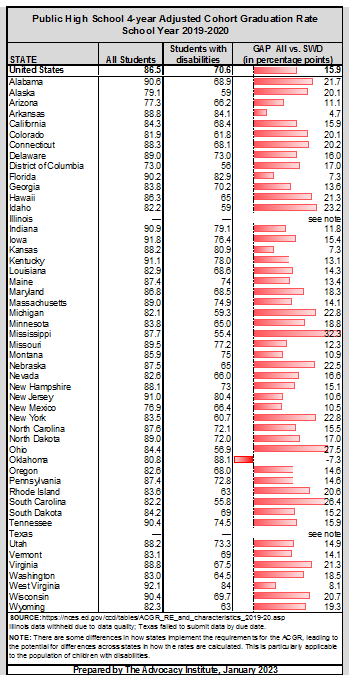
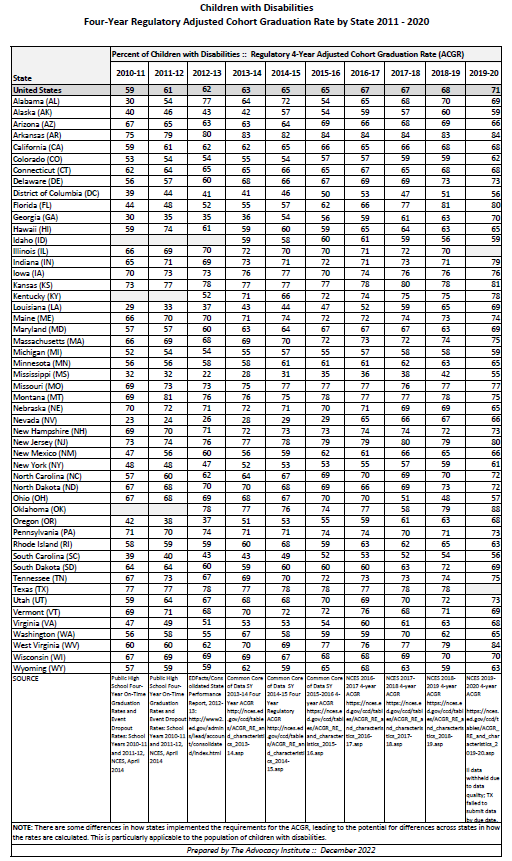
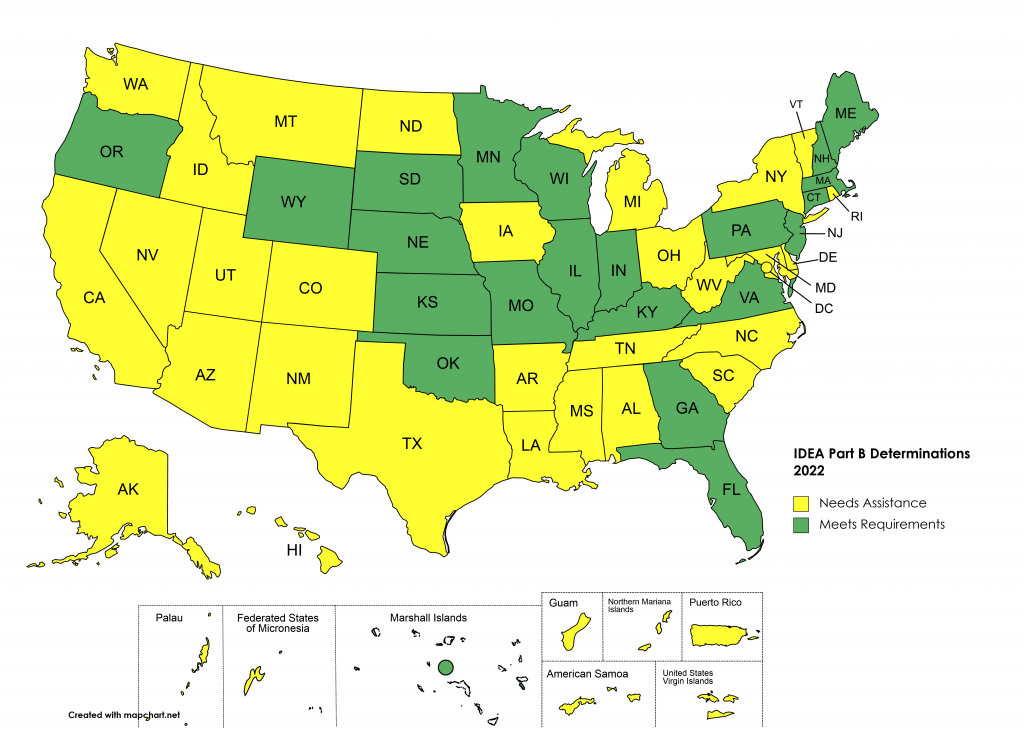
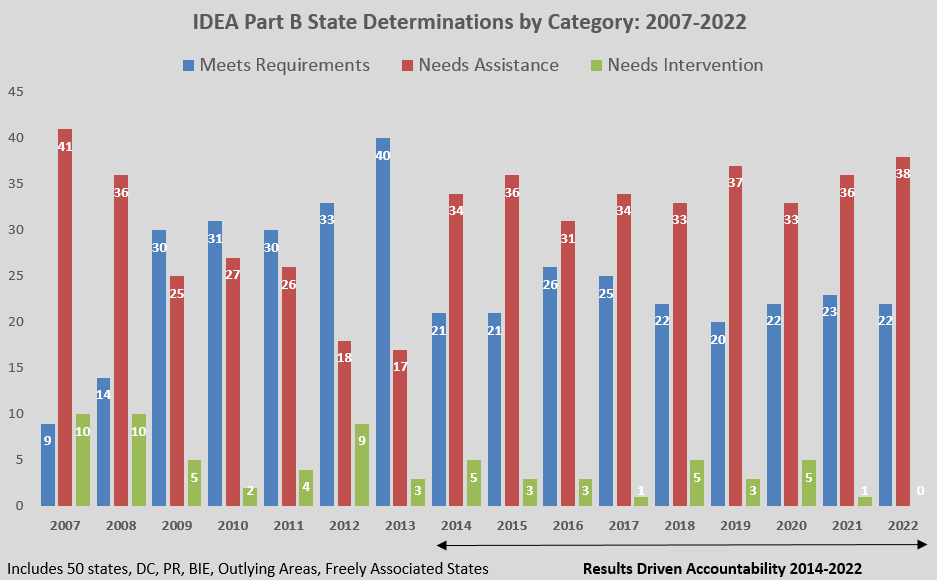
The U.S. Department of Education’s Office for Civil Rights (OCR) has announced that it intends to propose amendments to its regulations under Section 504 of the Rehabilitation Act of 1973, the landmark disability civil rights law. The Department is seeking suggestions from the public to help identify proposals that will best improve current regulations at 34 C.F.R. Part. 104. Interested parties may go to www.ed.gov/policy/rights/reg/ocr/ to submit suggestions.
OVERALL RECOMMENDATIONS
- OCR should revise the terminology used in the current
regulations from “handicap” or “handicapping condition” to “disability” and
other outdated language.
- The ADA Amendments Act provisions must be explicitly
integrated into the Section 504 regulations.
SPECIFIC RECOMMENDATIONS
34 CFR Part 104 Subpart D – Preschool, Elementary, and
Secondary Education
§104.31 Application of this subpart.
Revised regulations should explicitly state
that all public schools, including public charter schools, public virtual
schools, and typical public schools, as well as any non-public schools that
receive federal financial assistance directly or indirectly, are bound by the
provisions of Section 504, and that students with disabilities (and those
seeking to attend) in these institutions have the same Section 504 rights as
other public school students with disabilities. See, for example,
www2.ed.gov/about/offices/list/ocr/docs/dcl-factsheet-201612-504-charter-school.pdf
Revised regulations should explicitly
identify that Section 504 applies to a public online school operated statewide
by a public school district via contract with a private entity. (See Quillayute Valley (WA) School District,
49 IDELR 293 (OCR 11/26/07); see also
Elkhart (KS) Unified School District 218, 51 IDELR 51 (OCR 3/26/08) Online
school operated by school district and available to students across the country
required to inform students of the procedures to request accommodations and
should be able to provide, at a minimum, modifications to the regular education
program including test taking and assignment deadlines).
Further
to the above, there is wide spread misunderstanding that private schools are
exempt from Section 504. To address this, revised regulations should make clear
that non-public schools, such as private schools including religious schools,
that accept ANY form of federal financial assistance are required to adhere to
Section 504. Federal financial assistance includes such funds as free and
reduced lunch program, any funding program under the ESEA (Title I, etc.), IDEA
grants. Providing a non-exhaustive list would help further understanding of
this provision.
- Juvenile Justice facilities
Revised regulations should explicitly identify that all juvenile justice residential facilities and any other entities that receive Federal funds–either directly or indirectly through another State or local agency–and that provide educational services in such facilities are subject to Federal civil rights laws including Section 504. See
www2.ed.gov/about/offices/list/ocr/letters/colleague-residential-facilities-201412.pdf
- Before and after-school programs & summer programs
Revised regulations should include specific language indicating that before and after-school and summer programs operated by, and/or functioning on the premises of, and/or advertised by a school or district as the school or district’s before and after-school or summer program, are bound by Section 504 even if they are run by a non-district entity and even if that entity itself does not receive federal financial dollars. The regulations must specify that districts may not provide significant assistance to outside entities such as before and after-school programs and summer programs if those entities discrimination, even if that outside entity is not covered under Section 504.
§104.32
Location and notification
This is a critical area for regulatory
strengthening. Data from the Civil Rights Data Collection (CRDC) indicate a
serious lack of compliance with §104.32. Disability advocates have attempted to
highlight the evidence of serious violations as indicated by the CRDC. See https://c-c-d.org/fichiers/CCD-Education-TaskForce-Letter-on-504-Recs-12_18.pdf, www.civilrightsproject.ucla.edu/news/press-releases/2021-press-releases/national-analysis-details-troubling-levels-of-pre-existing-education-inequities-for-students-with-disabilities.
The current regulatory language is too
cursory to provide sufficient information to families, students, schools and
districts of the requirements for identification/child find under Section 504:
“A recipient that operates a public elementary or
secondary education program or activity shall annually: (a) Undertake to identify and locate every qualified
handicapped person residing in the recipient’s jurisdiction who is not
receiving a public education; and (b) Take appropriate steps to notify
handicapped persons and their parents or guardians of the recipient’s duty
under this subpart.” In addition, this language could be interpreted to mean
that a school or district only has to identify and locate potentially eligible
students, or notify students with disabilities and their parents of their duty
to do so, only once a year. To address
this problem, the regulations must contain stronger language regarding the
obligation of districts and schools to identify all potentially eligible
children. Information about Section 504 and how to ask for 504 services must be
shared in multiple ways with parents and on an ongoing basis. All staff must be
aware of their obligations to identify all potentially eligible students. Section
300.111 of the Individuals with Disabilities Education Act (IDEA) regulations
provide some guidance for this language: “The State must have in effect
policies and procedures to ensure that – all children with disabilities
residing in the State, including children with disabilities who are homeless
children or are wards of the State…regardless of the severity of their
disability…are identified, located, and evaluated; and a practice method is
developed and implemented to determine which children are currently receiving
needed special education and related services…Child find also must include –
children who are suspected of being a child with a disability…and in need of
special education, even though they are advancing from grade to grade; and
highly mobile children, including migrant children.” Note: Since the obligation
for child find under Section 504 rests with the school/district, “State” in the
above example should be replaced with “school and LEA.”
§104.33
Free appropriate public education
Across the nation, there is a major misunderstanding among schools and districts that only accommodations can be provided under Section 504. This is in direct conflict with the current regulatory language at
§104.33 (b).
Therefore, revised regulations must
provide explicit language that both regular and special education services and
related services as well as accommodations and nonacademic and extracurricular
activities available to students with disabilities are available under Section
504 and at no cost to families except to the extent that there are fees that
are imposed on all students and families including those without disabilities.
- Compensatory Services Under Section 504
OCR should make clear in revised
regulations that compensatory services can be awarded under Section 504. Seehttps://www2.ed.gov/about/offices/list/ocr/docs/fape-in-covid-19.pdf
§104.34
Educational setting
- Online/Remote/Virtual Instruction
Revised regulations
should include specific language that Section 504 should not prevent any school
from offering educational programs through distance instruction. See
www2.ed.gov/about/offices/list/ocr/frontpage/faq/rr/policyguidance/Supple%20Fact%20Sheet%203.21.20%20FINAL.pdf
§104.35
Evaluation and placement
- Parent Consent for initial evaluation
OCR’s interpretation that Section 504 requires informed parental consent for the initial evaluation must be included in revised regulations. In addition, revised regulations should require such parental consent to be in writing, as well as any district notification regarding evaluation.
- Requirements for evaluations
Revised regulations should include detailed information on (a) the need for qualified evaluators to do the evaluations, (b) the requirement for a timely evaluation (with a reasonable timeframe), (c) the right of parents to be part of the team that determines whether an evaluation will be conducted and if so, what it will entail, (d) the need to ensure that evaluations use tools and are conducted in ways that do not result in inappropriate identification or disproportionality, (e) that all evaluations must be conducted at no cost to the families and that families cannot be required to fund/produce their own evaluations, and (f) that any information, evaluations, etc. that parents bring to the Section 504 meeting must be reviewed and considered as part of the evaluation.
OCR guidance indicates that, if a child
is not eligible under IDEA, the school/district must consider potential
eligibility under Section 504. This should be explicitly included in revised regulations,
as should OCR guidance that a district may not simply refuse to evaluate a
child.
Revised regulations should also make
clear that schools/districts should consider providing 504 eligibility for
students with health conditions rather than providing such students with
“health plans” which do not provide the same level of protection and procedural
safeguards.
Independent
Educational Evaluation
Revised regulations should address the right to an independent educational evaluation at public expense including frequency, etc.
Non-Discrimination/Access
Issues
- Access to Accelerated Programs
Students with disabilities are routinely denied the opportunity to participate in accelerated programs such as Advanced Placement and International Baccalaureate classes or programs. OCR’s 2007 Dear Colleague Letter indicates that the practice of denying, on the basis of disability, a qualified student with a disability the opportunity to participate in an accelerated program violates Section 504. Revised regulations must explicitly address this. (See
https://www2.ed.gov/about/offices/list/ocr/letters/colleague-20071226.pdf)
- Access to Electronic Book Readers
Revised regulations should explicitly
include language about the need to provide access to assistive technology
including electronic book readers among other AT devices and tools in the
regulations. See
https://www2.ed.gov/about/offices/list/ocr/docs/dcl-ebook-faq-201105.html
- Access to Extracurricular Athletics
OCR’s interpretation of Section 504 that
students with disabilities must have an equal opportunity for participation in
nonacademic and extracurricular services and activities should be explicitly
included in revised regulations. See
https://www2.ed.gov/about/offices/list/ocr/docs/dcl-factsheet-201301-504.html
- Access to an education during public health emergencies
School officials have an obligation to avoid discrimination on the basis of disability under Title II and Section 504, while cooperating with public health authorities to ensure that students with disabilities have access to the school’s education program. This should be addressed in revised regulations. See www2.ed.gov/about/offices/list/ocr/docs/ocr-coronavirus-fact-sheet.pdf
OCR should explicitly indicate in revised regulations that bullying of a student on the basis of his or her disability may result in a disability-based harassment violation under Section 504. See www2.ed.gov/about/offices/list/ocr/letters/colleague-bullying-201410.pdf
- Discipline protections: Manifestation determination,
functional behavioral assessment, positive behavior support, limitations on
exclusions (consecutive or a series of short-term)
Revised regulations should clarify
requirements to conduct manifestation determination reviews and also to
identify exclusion from school for more than 10 consecutive school days or for
a series of short-term removals if the total days are more than 10 school days
and there is a “pattern” of exclusion. OCR considers an exclusion from the
educational program (for example, an out-of-school suspension) of more than 10
consecutive school days to be a significant change in placement. OCR also
considers a series of short-term exclusions (each 10 school days or fewer) from
the educational program to be a significant change in placement, if the
short-term exclusions total more than 10 school days and create a pattern of
removal. (See Parent and Educator Guide
to Section 504: https://www2.ed.gov/about/offices/list/ocr/docs/504-resource-guide-201612.pdf) Revised regulations should explicitly address this.
Note: In Springfield School District #186, 55 IDELR 206 (OCR June 29, 2010),
the Office for Civil Rights determined that a school district violated Section
504 when it expelled a student with a 504 Plan without conducting a
manifestation determination.
OCR should specifically address the use
of restraint and seclusion by school districts as behavior/actions that may
result in discrimination against students with disabilities, thereby violating
Section 504. In many states, the only students who are allowed to be restrained
or secluded are students with disabilities, which on its face should be
discrimination and a violation of Section 504. See
OCR should include in revised regulations
language indicating that all Section 504 plans and all communication related to
Section 504 plans, such as notice of 504 meetings, must be in writing.
Currently, OCR has indicated its position that schools may incorporate a 504
plan into a written document but are not required to do so. (See Parent
Educator Resource Guide,
www2.ed.gov/about/offices/list/ocr/docs/504-resource-guide-201612.pdf.)
This approach makes it virtually
impossible for families to participate effectively in the process, or even to
know what is contained in the 504 plan and how to ensure that the necessary services
are implemented. It is also unrealistic to expect teachers and other school
staff to be able to implement a plan that is not in writing.
Since current regulations state that
implementation of an IEP is one means of meeting the FAPE standard
(104.339b)(2)) revised regulations should, at a minimum, require that the
provision of FAPE require a written plan.
OCR should also include in revised
regulations the requirement for parent participation in the development,
updating, and/or revision to the 504 plan, and a requirement for at least
annual review and revision, as necessary, of the 504 plan. Currently, OCR
“urges” schools to allow for parental participation when considering any change
in the student’s Section 504 provision of FAPE, including location of services,
but does not require it. This minimizes the critical role of parents in the
decision-making process and makes it less likely that the decisions that are
made, including the contents of the 504 plan, will be appropriate and meet the
needs of the student with a disability. Additionally, revised regulations
should require the participation of the student with a disability starting no
later than transition age and certainly when the student becomes an adult.
- Transition – Legal Rights and Responsibilities of
Students with Disabilities as They Transition from High School to Institutions
of Postsecondary Education
OCR is encouraged to incorporate requirements regarding the critical transition from school to adult life in revised 504 regulations, including a requirement for schools to coordinate and collaborate with state and local adult service providers/systems and assisting students to connect with those adult services providers/systems. This will help avoid the current situation where students with disabilities who are not covered under IDEA are not aware of their potential eligibility for Section 504 protections in post-secondary education or the availability of adult services from agencies such as vocational rehabilitation. See https://www2.ed.gov/about/offices/list/ocr/letters/colleague-20070316.pdf
https://www2.ed.gov/about/offices/list/ocr/letters/parent-20070316.pdf
§104.36
Procedural safeguards
- Impartial hearing/complaints
Revised
regulations should make clear that 504 eligible students maintain their current
placement during the pendency of any impartial hearings requested by the
parents (i.e., stay-put).
Revised regulations should include language
indicating that the burden of proof to demonstrate compliance with the
requirements of Section 504 is on the school/district and not the parent, as
the school/district is the entity that has access to all the documents needed
to show compliance, and further, the district commits to complying with Section
504 as part of its receipt of Federal funds.
- Parent participation in decision-making
Revised regulations should significantly strengthen the procedural safeguards, including requiring informed, written parental consent for evaluations and at least the initial 504 plan; written notification of parental rights including the right to participate in all meetings related to Section 504 eligibility, evaluation and identification, and plan development and revision.
34
CFR Part 104 Subpart E Postsecondary Education
§
104.42 Admissions and recruitment
Require institutions to give “considerable weight” to documentation of both disability and the auxiliary aids and services previously provided (such as an IEP, 504 Plan, and/or Summary of Performance), and expand to non-examination contexts such as course, eligibility, and school services.
34
CFR Part 104 Subpart C Accessibility
- Building Accessibility (§104.23)
The regulations must be amended to
clarify that building accessibility must meet the ADA accessibility
requirements, keeping in mind the post-1977 construction standards that
buildings must, to the maximum extent feasible, be readily accessible to and
usable by persons with disabilities including not only students but also families
and staff.